Designing Immersive Audio for Blocky Worlds
How we balance low-fi 8-bit chiptunes with sweeping orchestral arrangements and complex, physically accurate spatial sound design inside voxel landscapes.
1. The Nostalgia Paradox: Why Blocky Visuals Demand Modern Ears
There is a common misconception in voxel and low-poly game development: that blocky graphics automatically demand blocky, flat audio. It is easy to fall into the trap of assuming that because a world is constructed of grids, its soundscape must remain equally simple. However, modern game audio design has proven that the opposite is often true. When visuals are stylized and abstract, the auditory space must work twice as hard to ground the player, establishing a physical sense of weight, atmosphere, and reality.
When players look at a blocky, digital landscape, their imaginations naturally fill in the gaps. Our goal with voxel audio is to supply the acoustic glue that transforms those low-poly cubes into massive, living monuments. We do not just trigger sound effects; we paint a rich acoustic canvas that contrasts with the geometric simplicity of the environment, creating a beautiful tension between what you see and what you hear.
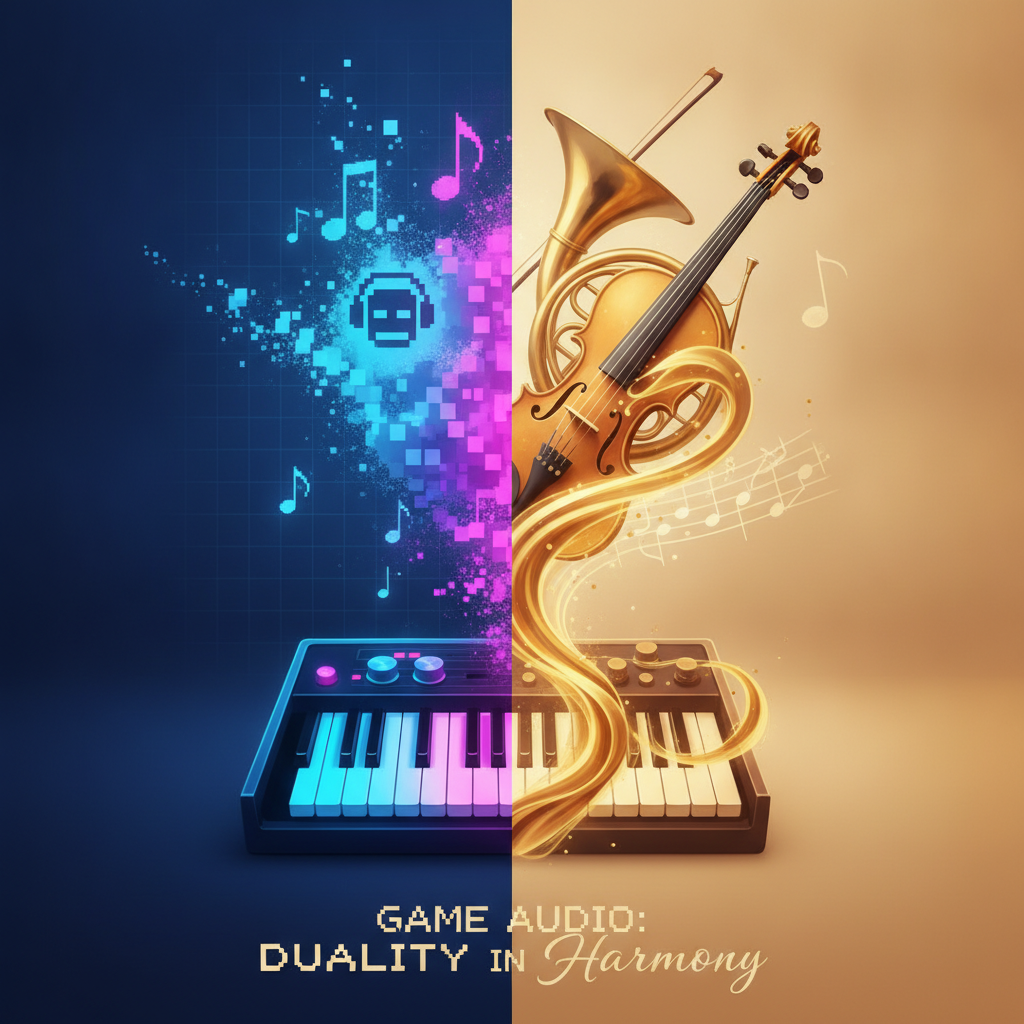
2. Chiptunes Meet the Symphony: Layering 8-Bit Gritty Synths with Orchestral Depth
How do you preserve the nostalgic charm of classic gaming while offering the cinematic weight players expect today? Our answer lies in hybrid composition. In crafting the indie game music, we refuse to choose between raw chiptunes and traditional orchestral scores. Instead, we layer them.
By blending custom NES-style square waves, triangle-wave bass lines, and gritty white-noise percussion with live recorded strings, brass, and warm analog synthesizers, we build an entirely new retro-modern genre. The chiptune elements provide the immediate, kinetic energy that matches the screen’s blocky aesthetic, while the orchestral layers provide emotional depth and scale.
“The magic happens when a lo-fi 8-bit arpeggio suddenly resolves into a soaring live cello line. It bridges the gap between digital abstraction and organic emotion.”
— Lead Audio Architect, ANVIL Studio3. The Physics of the Voxel: Crafting Realistic Spatial Audio in a Cubic World
Voxel worlds are uniquely structural. Unlike standard polygonal meshes, voxel terrain is made of predictable, modular cubes of varying materials: dirt, stone, metal, glass, or water. This modularity gives us an incredible technical advantage for game audio design.
We utilize dynamic ray-casting inside our sound engine to simulate how sound bounces off different block configurations. When a player fires an engine thruster or drops a heavy tool inside a narrow stone cavern, our spatial sound effects systems calculate real-time acoustic occlusion, absorption, and early reflections.
A sound originating in a tight wooden corridor will sound dead and boxy, whereas the same sound triggered in an expansive granite cavern will bloom with a rich, metallic decay. This physical authenticity forces the player to read the landscape with their ears, transforming the blocky world from a flat visualization into a tangible, physical playground.
4. Sound Effects That Click: Designing Tactile, ASMR-Like Audio for Low-Poly Blocks
In a sandbox or voxel environment, interaction is constant. Players spend hours mining blocks, placing structures, and organizing inventories. If these repetitive interactions sound generic, player fatigue sets in quickly. That is why we treat sound effects as tactile, ASMR-like rewards.
We design voxel sound effects using high-frequency transients and clean, satisfying mechanics. Mining stone shouldn’t just be a dull thud; it should offer a crisp, glass-like fracture sound. Placing a metal block should reward the player with a heavy, pressurized clink that carries acoustic weight. By emphasizing the immediate click and tactile snap of block interactions, we turn basic construction and resource gathering into a sensory pleasure loop.
How we build click-y voxel sounds:
- The Click: An ultra-fast high-frequency peak (< 5ms) to simulate structural fracturing.
- The Core: Organic textures (shattered slate, dry dirt, snapping twigs) recorded at high sample rates.
- The Tail: Spatialized acoustic decay matching the surrounding voxel material density.
5. The Dynamic Mix: How We Program Audio to Shift from Quiet Exploration to Epic Boss Battles
A great game soundtrack is never static. It must breathe with the player’s actions. In our audio engine, we use state-driven sound parameters to dynamically morph the mix.
During peaceful moments of cave exploration, the music drops to an ambient murmur—soft, sweeping synth pads layered with occasional sparse piano notes. But the moment a player breaches a hostile underground dungeon, the engine seamlessly introduces real-time sub-mixes. A driving chiptune drumbeat fades in, low-frequency brass sections begin to swell, and the spatial reverb tightens to heighten the adrenaline.
This real-time adaptive mixing ensures that transitions are completely fluid, avoiding jarring track changes and maintaining the immersive flow state that is so crucial to sandbox gameplay.
6. Your Turn to Build: 3 Rules for Your Next Indie Game Audio Design
Ready to start designing sound for your own blocky masterpiece? Keep these structural rules in mind to construct a highly tactile and emotionally engaging auditory environment.
Embrace Contrast
Do not match simple visuals with simple sound. Use high-fidelity, dynamic spatial sound effects to make low-poly environments feel physically real.
Prioritize Key Transients
Ensure interactive sound effects have immediate, satisfying high-frequency “clicks”. This provides instant tactile feedback to highly repetitive actions.
Layer Low-Fi with Hi-Fi
Don’t abandon chiptunes. Layer raw, nostalgic retro synthesizers over deep, acoustic, live orchestral instruments to achieve structural and emotional weight.
Build Your Next Audio Masterpiece With Us
Our team of technical sound designers and composers are constantly pushing the limits of voxel audio. Contact our sound lab today to consult on your indie game music implementation, custom SFX libraries, and spatial mix integration.
Initialize Audio Consultation //>